Themes as modules, for kids
2026-10-02 · Architecture ·
 Nativa Dev
A theme used to be a thing rather than a place. Not a class, not a file — a decision, a colour and a padding, scattered across whichever template happened to need them.
The first part of this series is about how a scattered mixture becomes a module: one place you can open and read.
What it was before
Three reasons the mixture spread. Each looked entirely reasonable, which is exactly why it lasted so long.
- Colours inline in markup, where nobody went looking for them.
- Margin decisions living in a template instead of a token.
- Branches on whether something was “our” theme or not.
A theme was not a thing. It was a mixture that looked like one.
The contract
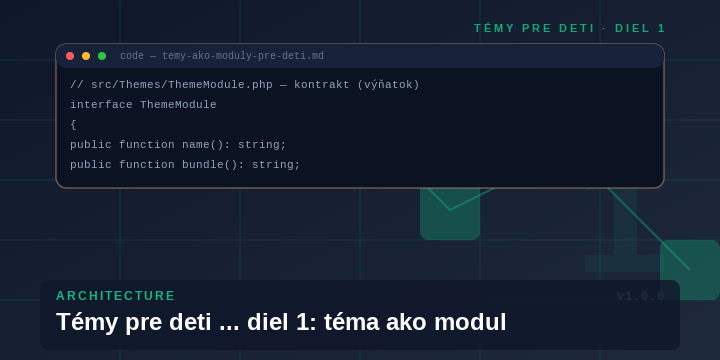
An interface. Sixteen methods: eight for identity and assets, three for the chrome, and one per public surface.
public function header(ShellContext $context): string;
public function footer(ShellContext $context): string;
public function pageWrap(string $content): string;
public function homepage(PageContext $context): string;
public function blogIndex(PageContext $context): string;
public function blogArticle(PageContext $context): string;
The connector
One file knows that erik means ErikTheme.
Nothing else knows anything about themes — and an architecture test
enforces it.
What stays in the core
The head connector. Metadata, JSON-LD, the nonce — that belongs to
the kernel, not the theme. A theme starts after
<body>.